
Bronx Zoo and I Don't Mean the Late 1970s New York Yankees!

The New York Yankees teams of the late 1970s were nicknamed the Bronx Zoo due to many players, their owner (George Steinbrenner), and manager (Billy Martin who somehow got hired and fired 5 times from the late 1970s until before he died on December 25, 1989) having high egos and large personalities which led to brawls with other teams and even ugly disagreements with each other that would play out in the press. However, this blog entry is not about them. This blog entry is all about the literal animals that call the Bronx call home.
On Wednesday, June 17, 2026, I went to the Bronx Zoo with my aunt who was visiting from Minnesota and my parents. Wednesdays are free to go (free if you buy a ticket to do the bare minimum and some cost if you add on unlimited star attractions ($9.95 to $14.95 depending on demand) or $7 per additional star attraction). You can reserve tickets here. A map of the zoo can be found here. The number of parents with toddlers was large although the crowd was moderate due to the fact that K-12 school was still in session.
We started by getting views of the Bronx River and waterfall as shown below.


We then saw the Bison native to the North American Great Plains. The Bison rebounded from near extinction in the early 1900s albeit at low numbers than the peak before being heavily hunted.


Bison Description Signs and Bison
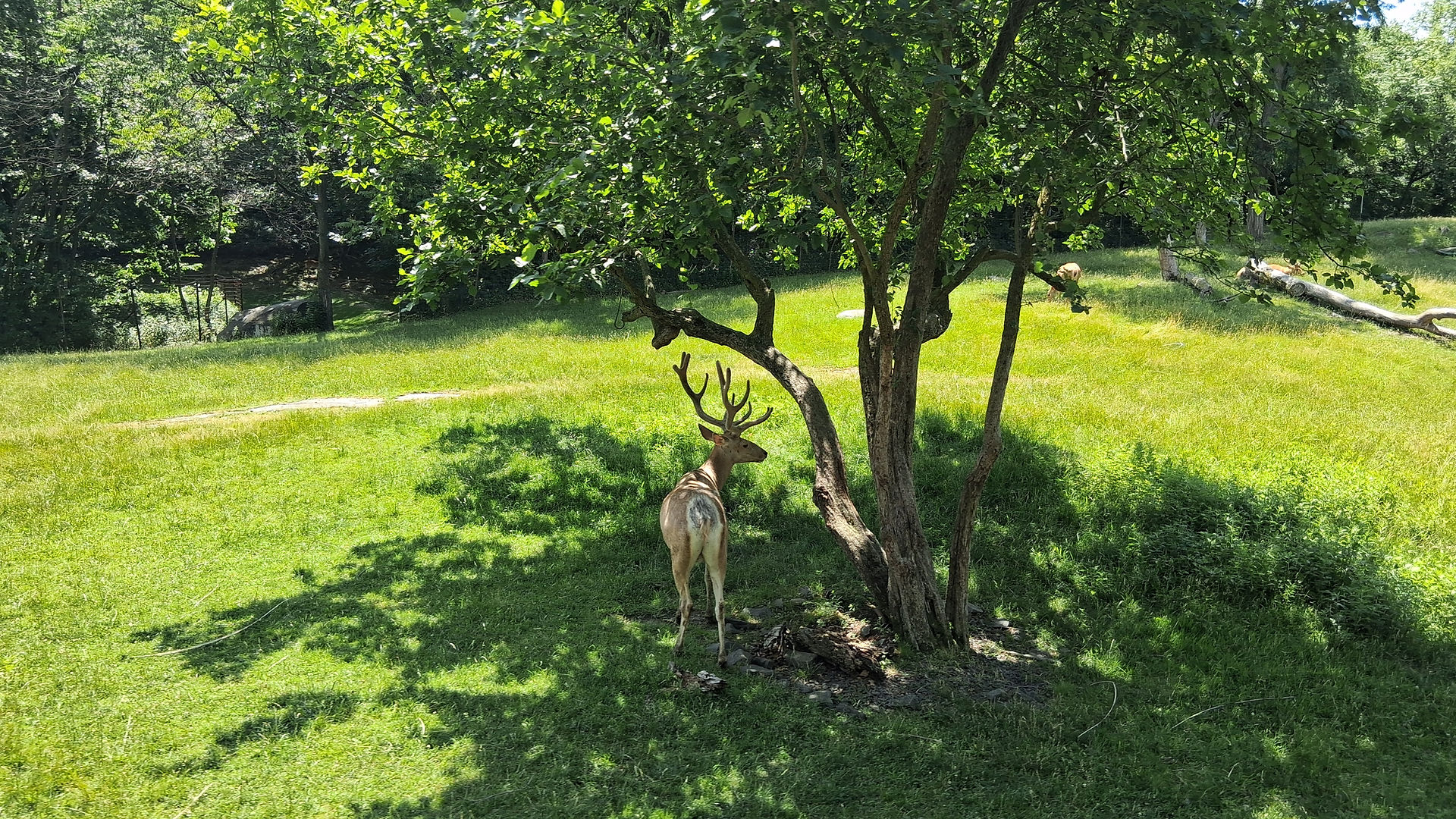
Next, we saw Pere David's deer. Pere David's deer are native to China. Pere David, a Westerner, observed these deer in China and sent them them to Paris for identification. This was a notable find as the deer were presumed to be extinct around 200 A.D. due to hunting in the 200 years prior.

We then saw a blue jay that was not part of an exhibit but in its natural habitat.

After that, we observed a swan.

Next, we boarded the Wild Asia Monorail where we got a guided tour of many different animals through announcements from the train engineer. The Wild Asia Monorail is open from May to October only and is subject to closure depending on the weather.

We started by getting an arial view of the Bronx River.

We then saw tufted deer. It is notable for the tufted black hair on its forehead.

Tufted Deer
Next, we saw Przewalski's horses. These horses, named after Russia explorer and geographer Nikolaj Przewalski, are the last wild horses. In 1881, Przewalski discovered a skeleton of the horse in the course of his exhibition. He became the first person to determine that the skeleton pertained to a species unknown to past European science. These horses are native to Mongolia, a country located in Asia, and are critically endangered.


Przewalski's Horses
After that, we saw gaur as known as Indian bison. Gaur are native to South and Southeast Asia. Since 1986, the species has been marked as vulnerable on the IUCN Red List. The International Union for Conservation of Nature (IUCN) is a membership-based group of more than 1,400 organizations consisting of government agencies, non-governmental organizations, Indigenous organizations, and other conservation organizations and groups from around the globe that work to protect the world's nature. IUCN is a trusted scientific guidance tool for intergovernmental organizations. The IUCN classification of vulnerable means that gaur have a high risk of extinction in the wild. Vulnerable is the fourth most classification risk of the IUCN Red List categories away from being extinct. The full IUCN Red List can be found here. Gaurs are threatened by illegal hunting.

Continuing on the tour, we observed a peacock as shown below.

Later on the train ride, we saw an elephant.

After that, we saw a greater one-horned rhino.

We then saw Turkmenian flare-horned markhor, a type of goat.

We then passed a sleeping red panda.

We then got off the Wild Asia Monorail. After that, we passed a sign that said it was a quiet area but ironically it was not quiet at all.

Finally, we saw Nubian ibex, a type of goat, which are native to northeast Africa and the Middle East. Nubian ibex are listed as vulnerable on the IUCN Red List. Nubian ibex are threatened by illegal hunting, habitat loss, and global warming.

We then got on the Zoo Shuttle (a outdoor shuttle with a roof) and took it close to an exit point of the zoo. The Zoo Shuttle runs from April to October on weekdays only and is weather dependent. We then walked to the exit and back to my parents' car in a parking lot to go home. It costs $22 to park a car at the zoo. Information on parking and driving directions to the zoo can be found here. I want to note that parking lots can get full on peak attendance days. When lots get full, alternative parking can be found at Fordham University for $25. The location can found by clicking here. From there, it is an approximately 8 minute walk to the zoo. The zoo can also be reached by subway, car service, bus, and Metro-North trains (more information can be found here).
--
Sources


