
Artemis II: T Minus 10 and Counting, 9, 8, 7, 6, 5, 4, 3, 2, 1, Blast Off!

From Wednesday, April 1st to Friday, April 10th, 2026, I was closely following the Artemis II mission to the Moon. I have a passion for astronomy so for me this was a good distraction from the negative news in the world.
On the evening of April 1st, I watched the launch live on NASA+, the National Aeronautics and Space Administration's (NASA)'s ad-free on-demand streaming service where you do not need a subscription. The exact time of the launch was 6:35 PM Eastern Daylight Time. The launch occurred from Kennedy Space Center's Launch Complex 39B in Florida. This area is also known as the Space Coast and is located next to the Atlantic Ocean.
This was exciting for me because, although I have watched launches before, I have never watched a launch that sent four astronauts to approximately 4,067 miles above the lunar surface and then back to Earth. The astronauts are as follows: Commander Reid Wiseman, pilot Victor Glover, and mission specialist Christina Koch from NASA; and mission specialist Jeremy Hansen from the Canadian Space Agency. The last time humans were sent to the Moon was the Apollo 17 mission in December 1972, well before I was born which was in 1988. This mission differed from the Apollo 17 mission in that Apollo 17 landed on the Moon while this mission flew by the Moon, in other words the astronauts stayed in Outer Space above the lunar surface.
One of the more exciting aspects of watching this was actually the pre-launch, two commentators described in great detail one of the objectives of the mission, to have the spacecraft travel further than any spacecraft with humans on it has ever traveled from Earth. The previous record was set by the Apollo 13 astronauts in 1970 of 248,655 miles from Earth. One of the points of this mission is so that humans can closely study the lunar surface.
It was also exciting to hear why some of the astronauts decided to go to the Moon. For Victor, "We are going for our families." For Christina, "We are going for our teammates." For Jeremy "We are going for all humanity." I also watched NASA Artemis II launch director Charlie Blackwell-Thompson give these inspiring words to the astronauts from the NASA Kennedy Space Center "Reed, Victor, Christina, and Jeremy. On this historic mission, you take with you the heart of this Artemis team. The daring spirit of the American people and our partners across the globe and the hopes and dreams of a new generation. Good luck. Godspeed, Artemis II, let's go."
Below is a picture of the launch.

You can also watch a video of the launch below.
Admittedly, watching the launch was exciting but also nerve racking. The fear that something might go wrong was all too real. The Challenger explosion tragedy of 1986 was very much in my mind and always is watching launches. For those who do not know, the Space Shuttle Challenger launched on January 28, 1986 and exploded 73 seconds after launch at an altitude of 46,000 feet. All seven crew members died.
Following the launch, the astronauts began their journey to the Moon. Below is a video showing the approximate Artemis II Flight Path.
It took Artemis II 5 days until it reached it's closest approach to the Moon. The astronauts took many photos including this beautiful one of Earth on April 2 shown below.

It took the astronauts five days for the mission to reach its closest point to the Moon on April 6th. The spacecraft was approximately 4,067 miles above the lunar surface at approximately 7:00 PM. In just around 2 minutes later, the mission became the farthest humans had ever traveled into space from Earth: 252,756 miles away. This was 4,111 miles further than the Apollo 13 crew travelled in 1970 according to NASA. Below is a picture of the Moon with the Earth in the background taken by the Artemis II crew.

It was also on this day, the astronauts had a view of a total solar eclipse. A total solar eclipse is when the Moon is in alignment with the Sun. The Sun and Moon appear to both be the same size (although in reality the Sun is much larger than the Moon). As a result of the Sun being blocked, the Sun's corona (outer atmosphere) can be observed as seen below.

Glover described the corona as baby hair as shown in the picture below.

Interesting, an objective of this mission was to prepare for a mission to the Moon in 2028 where humans land on the South Pole. The astronauts would then create a base on the surface. The astronauts would use ice at the South Pole to divide H2O molecules into hydrogen and oxygen. The oxygen would be used to breath while the hydrogen would be used as fuel to launch a mission to Mars. The reason to lift off from the Moon as opposed to Earth is it requires less fuel to lift off from the Moon because the Moon has less gravity than Earth. The fact that we even have the technology to do this is what fascinates me.
One point I heard from a science show for sending people to the Moon and, perhaps, Mars one day is that people can give a descriptive analysis of what they are seeing from their unique vantage point in space.
The final part of the Artemis II mission was watching the astronauts return to Earth which occurred on April 10th. I watched live as the astronauts approached and then entered Earth's atmosphere. The spacecraft hit Earth's atmosphere at 24,000 mph. Note the sequence of events for reentry below.

The image below shows the landing path.

Two rounds of parachutes were released to slow down the spacecraft. The spacecraft splashed down in the Pacific Ocean off the coast of San Diego at 8:07 PM. This was one of the coolest things I have even seen. A picture of the splashdown is shown below.

My sister was closely following the Artemis II Mission. I had a phone conversation with her where in part we discussed the splashdown. It took longer than expected to get the astronauts out of the spacecraft because strong ocean currents made it hard to stabilize the spacecraft.
The picture below shows the large number of people needed to assist with stabilization and removing the astronauts from the spacecraft. The five orange balloons on top of the spacecraft were inflated with helium to keep the spacecraft stable and upright.

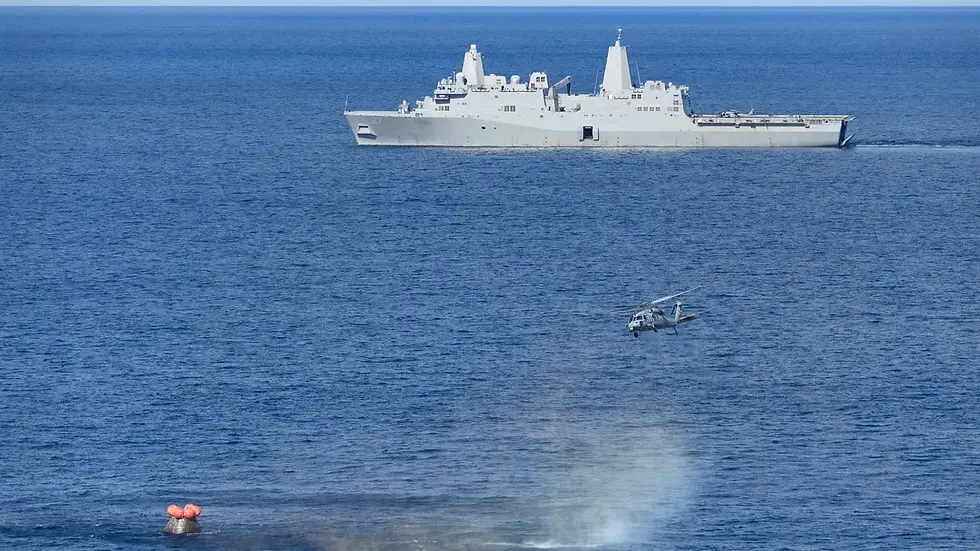
After the crew were removed from the spacecraft, they were airlifted one by one from the life raft by two helicopters to the Navy ship USS John P. Murtha.

The Navy ship USS John P. Murtha is shown below.
A close up view of where one of the helicopters landed on the ship is shown below.

I enjoyed watching this mission as it brought the United States as a country together. I look forward to future Artemis missions to learn more about the Moon and Outer Space.
--
Sources
https://www.nasa.gov/blogs/missions/2026/04/01/live-artemis-ii-launch-day-updates/
https://abcnews.com/Technology/artemis-iis-moon-mission-1st-50-years-us/story?id=131572016
https://www.cbsnews.com/live-updates/artemis-moon-lunar-flyby/
https://www.cnn.com/2026/04/10/science/live-news/artemis-2-splashdown-astronauts-return
https://www.npr.org/2026/04/11/nx-s1-5781820/artemis-ii-splashdown-captures-nationwide-attention


